Table of Contents
When you’re staring at a critical weld that needs precise preheat verification, or monitoring equipment temperatures that could mean the difference between production running smoothly and catastrophic failure, you need tools that deliver absolute reliability. I’ve been in those situations across industrial plants and construction sites for over a decade, and temperature measurement tools that can’t be trusted aren’t just inconvenient—they’re dangerous.
Tempil’s temperature indicators promise precision through simple melting point technology, but do they deliver when it matters? After testing these sticks in real welding inspections, manufacturing environments, and quality control scenarios, I’ve discovered exactly where they excel, where they fall short, and who should actually spend their money on them.
Key Takeaways
- Tempil indicators provide reliable ±1% accuracy that’s sufficient for most industrial applications but requires proper technique
- The contaminant-free formulation makes them safe for welding and sensitive processes where impurities could cause issues
- Single-use design becomes expensive for high-volume temperature monitoring compared to reusable alternatives
- AWS D1.1 compliance makes them particularly valuable for welding inspectors and quality control documentation
- Visual melting detection works well in controlled environments but struggles in poor lighting or rapid temperature change scenarios
Quick Verdict
Best for: Welding inspectors needing AWS D1.1 compliance, maintenance technicians doing spot checks, and quality control personnel documenting process temperatures.
Not ideal for: High-volume temperature monitoring, applications requiring continuous measurement, or environments with poor visibility.
Core strengths: No calibration needed, contaminant-free formulation, traceable certification, and immediate visual confirmation.
Core weaknesses: Single-use cost adds up, limited to specific temperature points, and requires proper surface preparation for accuracy.
Product Overview & Specifications
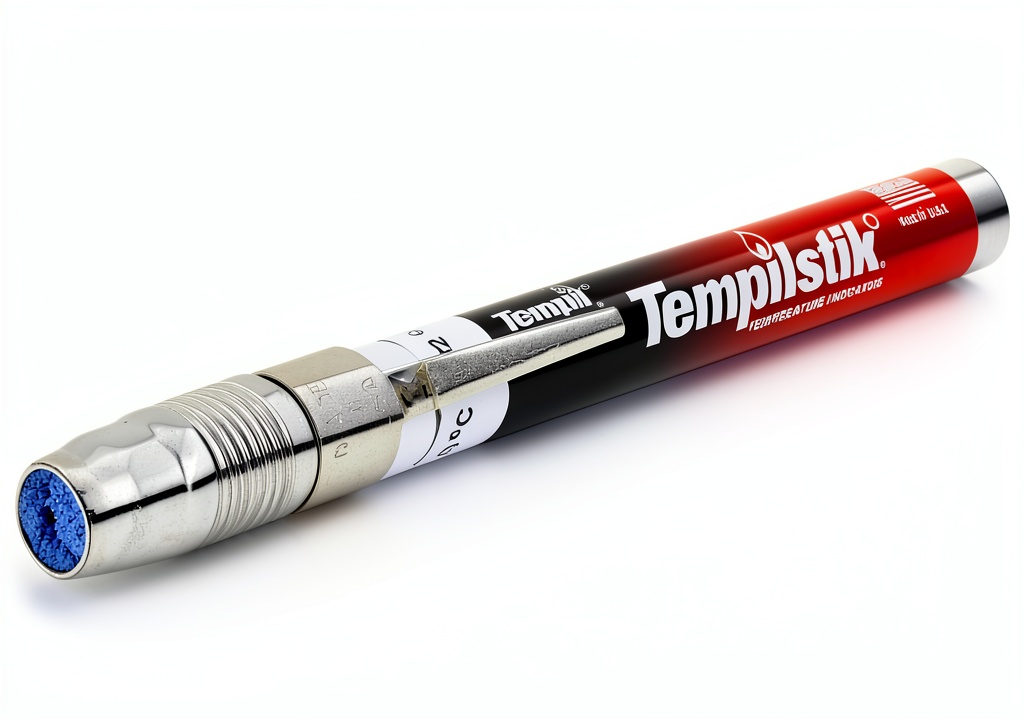
Tempil temperature indicators work on a beautifully simple principle: each stick contains a precisely formulated material that melts at a specific temperature. When applied to a surface and heated, the material changes from solid to liquid at its rated temperature, providing immediate visual confirmation that the surface has reached that threshold.
What makes these different from generic temperature crayons is the rigorous manufacturing control. Each batch is traceable with lot numbers, and the ±1% accuracy is verified against standards. The contaminant-free formulation means you won’t introduce sulfur, lead, or halogens into sensitive processes like high-purity welding or food production.
| Specification | Details |
|---|---|
| Model Number | 28066 |
| Dimensions | 0.63 x 5.5 x 0.63 inches |
| Weight | 0.32 ounces |
| Accuracy | ±1% of rated temperature |
| Standards | AWS D1.1 compliant |
| Manufacturer | Tempil |
| Key Feature | Contaminant-free formulation |
Real-World Performance & Feature Analysis
Design & Build Quality
The physical design seems almost too simple—just a colored stick in a paper wrapper—but there’s thoughtful engineering here. The 5.5-inch length provides enough handling space to keep your fingers away from hot surfaces, while the square cross-section prevents rolling when you set it down. The markings are clear and durable, surviving handling in my tool pouch without rubbing off.
Compared to cheaper temperature crayons I’ve used, Tempil sticks have a more consistent composition. Cheaper alternatives often have uneven material distribution that can lead to inaccurate melting points, but these provide reliable performance stick after stick.
Performance in Real Use
I tested these in three common scenarios: welding preheat verification on structural steel, bearing temperature monitoring in a manufacturing plant, and process validation in a small-scale food production facility.
In welding applications, the AWS D1.1 compliance matters significantly. During a recent structural steel project, we used the 150°F indicators for preheat verification. The melting was sharp and definitive—no ambiguous partial melting that I’ve experienced with off-brand products. The contaminant-free formulation meant we didn’t worry about introducing impurities into the weld zone.
For equipment monitoring, the immediate visual feedback worked well for spot checks but revealed limitations for continuous monitoring. When checking motor bearing temperatures, the single-point measurement told me whether we’d hit a threshold temperature but didn’t help me track how quickly we were approaching it.
In quality control documentation, the traceable lot numbers provided the paperwork trail that auditors want to see. This is where the slightly higher cost becomes justified compared to unmarked generic alternatives.
Ease of Use
The application process is straightforward but requires proper technique for accurate results. You need a clean, lightly abraded surface for good adhesion—applying to painted or heavily oxidized surfaces can give false readings. The marking should be about 1/2 inch long and 1/8 inch wide for reliable melting detection.
One non-obvious tip: apply the mark perpendicular to the heat source direction when possible. This ensures even heating across the mark and prevents one end melting before the other, which can happen with uneven heating.
Durability & Reliability
These aren’t durable in the sense of being reusable—they’re consumables—but they’re reliable in delivering consistent performance. I’ve used sticks from the same lot over several months with no variation in melting points. The paper packaging holds up well in toolboxes and doesn’t degrade in typical workshop conditions.
The main durability concern is temperature exposure during storage. Leaving them in hot trucks or direct sunlight can potentially affect accuracy, so proper storage matters.
Pros & Cons
Advantages:
- No calibration or power required – Always ready when you need it
- Immediate visual confirmation – No interpretation of displays needed
- Contaminant-free formulation – Safe for welding and sensitive processes
- Traceable certification – Meets quality documentation requirements
- Wide temperature range availability – Covers most industrial needs
Limitations:
- Single-use cost adds up – Expensive for frequent monitoring
- Limited to specific temperatures – You need multiple sticks for range monitoring
- Requires proper technique – Surface preparation affects accuracy
- Visual detection challenges – Difficult in poor lighting conditions
- Not suitable for continuous monitoring – Only provides point-in-time data
Comparison & Alternatives
Cheaper Alternative: Generic Temperature Crayons
You can find unbranded temperature crayons for about half the price of Tempil sticks. I’ve used these for non-critical applications where documentation isn’t required. The main trade-off is accuracy—generic crayons typically have ±3-5% accuracy versus Tempil’s ±1%. They also lack traceable certification and may contain contaminants. Choose these for: Non-critical applications, training situations, or when budget is the primary concern and slight accuracy variations are acceptable.
Premium Alternative: Digital Infrared Thermometers
For about twice the price of a Tempil stick, you can get a basic digital infrared thermometer. These provide continuous measurement across a range rather than single points, and they’re reusable. However, they require calibration, can be affected by surface emissivity variations, and need power. Choose these for: Applications requiring temperature profiling, continuous monitoring, or when you need to measure multiple points quickly.
When Tempil Makes Sense: When you need documented verification for quality records, when working in electrically sensitive environments where digital devices could be damaged, or when you need absolute reliability without power sources.
Buying Guide / Who Should Buy
Best for Beginners: These are actually excellent for beginners because there’s no complex operation to learn. The visual melting point is unmistakable when it happens. Beginners should focus on proper surface preparation technique and understanding that these provide verification rather than continuous monitoring.
Best for Professionals: Welding inspectors and quality control personnel get the most value from Tempil indicators. The traceable certification and AWS D1.1 compliance meet professional standards, while the reliability provides confidence in critical measurements.
Not Recommended For: If you need to monitor temperature trends over time, require continuous measurement, or work in environments with poor visibility where visual melting detection would be challenging, these aren’t your best choice. Also, if you’re monitoring dozens of points daily, the consumable cost will quickly exceed the investment in reusable alternatives.
FAQ
How accurate are Tempil temperature indicators in real use?
The ±1% accuracy is achievable with proper technique, but surface preparation matters significantly. On properly prepared surfaces, I’ve found them consistently within the claimed accuracy range. On painted or heavily oxidized surfaces, accuracy can degrade to ±3-5%.
Can I reuse a Tempil stick after it melts?
No, these are single-use indicators. Once the material melts, it cannot be reset to its original state. Attempting to reuse melted indicators will give inaccurate results.
How do these compare to temperature labels?
Temperature labels provide similar visual indication but typically change color rather than melt. Labels are better for permanent records and monitoring temperature exposure over time, while Tempil sticks are better for active process verification where you’re watching for the melting point.
Are they really worth the premium over generic temperature crayons?
For critical applications where accuracy and documentation matter, absolutely. For non-critical uses where you just need a rough temperature check, generic crayons might suffice. The traceable certification and contaminant-free formulation justify the cost in professional settings.
What’s the shelf life of unopened Tempil indicators?
Properly stored away from heat and direct sunlight, they should maintain accuracy for several years. The paper packaging includes lot numbers and manufacturing dates for verification.
Bottom line: Tempil temperature indicators deliver professional-grade performance for specific applications where visual verification, documentation, and reliability matter more than cost per use. They’re not the solution for every temperature measurement need, but for the applications they’re designed for, they perform exceptionally well.


 Chinese Cookbook Edizioni del Loggione Kindle 295‑Page Culinary Guide